Don't Fear Disney, Create Rural IP

When Shanghai Disneyland opened, Wang Sicong’s father, China’s good father-in-law Wang Jianlin, said that we (Wanda) would make Disney China unable to make a profit in the next 10 to 20 years. Many self-media, including the Wu Xiaobo Channel, helped Boss Wang calculate an account and supported the correctness of his point of view. I also agree very much. Because, under the environment of consumption upgrading, the rural cultural tourism industry has more potential than Disneyland. The logic supporting this conclusion is:
In terms of geographical advantages, Chinese cities only occupy one-tenth of the land area, and more than 8.9 million square kilometers of land are vast rural areas. Future opportunities must be in rural areas, not in crowded cities like Shanghai.
In terms of development potential, China’s rural areas, from south to north, from east to west, can be said to have different customs every ten miles and different customs every hundred miles. The traditional cultural accumulation resources that can be explored are rich and not comparable to a single Disney company IP.
In terms of consumer psychology, mainland China, Hong Kong, Taiwan and the entire Greater China region are agricultural nations. We have a natural affinity for land, crops, pigs, cattle, sheep, chickens, ducks and geese. There is a very interesting phenomenon. Our diplomatic missions, our global enterprises such as Huawei and ZTE, go to Africa and South America to open up markets. When they go to a place and settle down their accommodation, the next thing is to open up a vegetable garden and start growing vegetables. Within a few days, they will start raising chickens and ducks. We Chinese people pay attention to farming and reading as a family heirloom, are reluctant to leave our native land, and return to our roots. This is the fundamental. Disney culture is just a kind of Western fast food, just like we treated imported instant noodles as a treasure more than ten years ago, and now it is just synonymous with junk food, and millet steamed buns are the favorite. Snow White and Donald Duck definitely can’t beat Lady White and the Monkey King.
In terms of realistic needs, modern city life is full of reinforced concrete and traffic noise. Everyone is in a highly tense and fast-paced working environment, and it is inevitable to be anxious and irritable. Disneyland has a small space and is overcrowded, which is not a good place to relax. The quiet rural environment is the most suitable choice.
Of course, to create a rural cultural tourism IP, it is not as simple as just cleaning up an old house, putting a few tables, a few beds, and doing farmhouse entertainment. Instead, we need to dig deep into resources, operate carefully, and create hit products.
Abroad, we can learn from Kumamoto Prefecture in Japan. Originally, Kumamoto Prefecture was just a backward agricultural prefecture. Around 2011, the local government began to dig deep into the agricultural cultural tourism industry, and from scratch, created Kumamon. Through the drive of Kumamon, the economic development level of Kumamoto Prefecture has surpassed the local surrounding prefectures, and Kumamon has also become a high-quality IP resource for Kumamoto Prefecture.
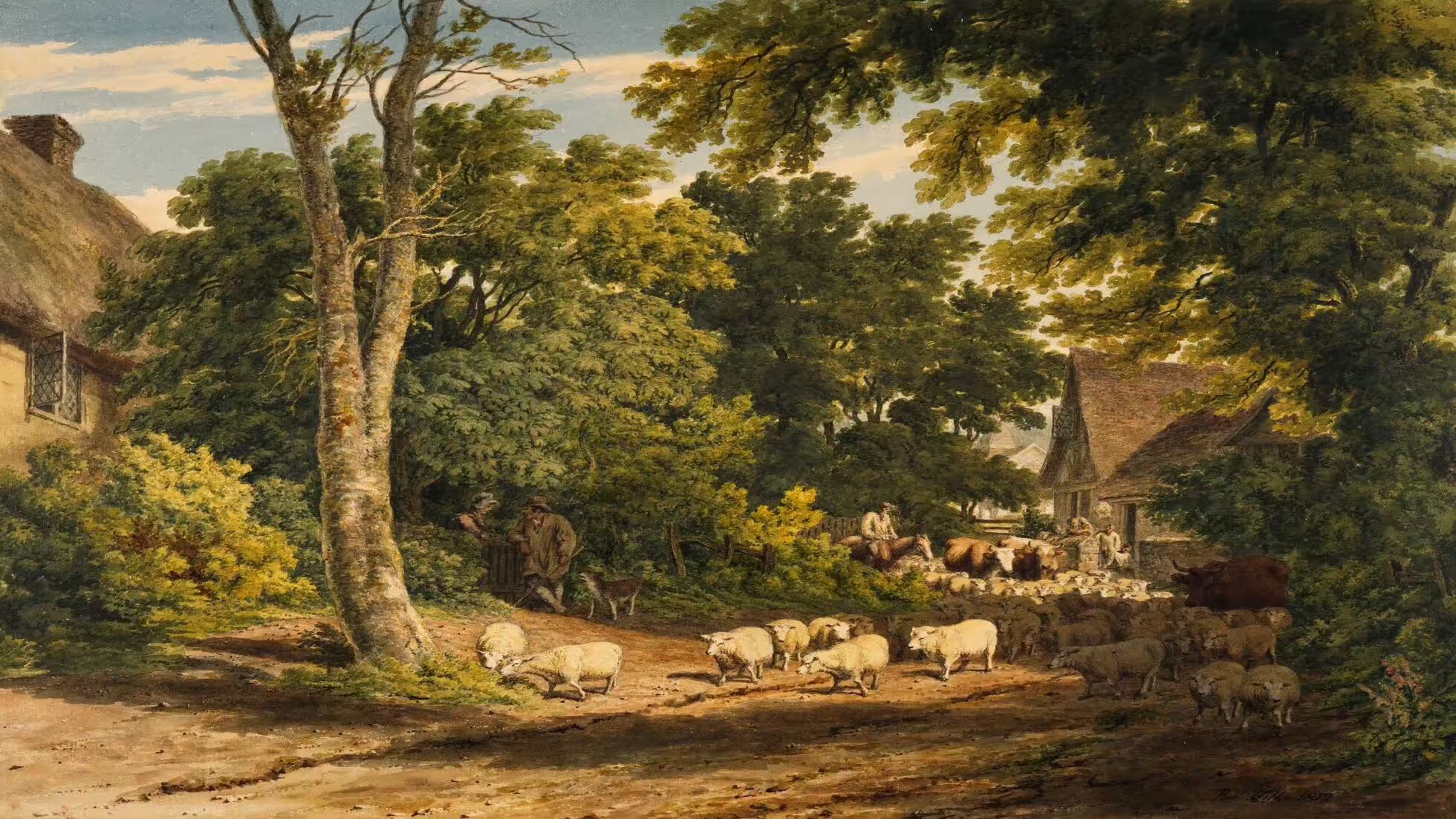
Domestically, we can learn from the “Yangjiale” B&B brand in Deqing, Zhejiang. Starting in 2007, Deqing Mogan Mountain began to build the “Yangjiale” brand. From the beginning, the local government did not encourage farmers to take the farmhouse entertainment route, but the boutique high-end B&B route. The government unifiedly planned the renovation of the big ecology, the big environment, improved traffic, built walking trails, and helped owners create personalized B&Bs. Now, several well-known B&B brands such as Yinxi 39 have appeared under the “Yangjiale” brand. It is reported that the daily accommodation cost per room in Yinxi is 4000-6000 yuan, and the reception plan has been scheduled to December. Even, one of the B&Bs transformed from a pigsty costs more than 1500 yuan per day. Deqing B&B appeared as a test question in the 2016 National College Entrance Examination (Category B) geography test paper, and the “Yangjiale” brand has received widespread attention.
In the Internet age, we only pay attention to the first brand, not the second brand, just like we only care that Mount Everest is the world’s highest peak, and do not care which mountain is the world’s second highest peak. Therefore, entrepreneurs who want to create rural IP should not think about creating a second “Kumamon” or a second “Yangjiale”. Instead, they should adapt measures to local conditions, dig deep into local characteristics, systematically organize local culture, and develop their own IP. After development, it is necessary to promote and apply this IP through various channels such as B&B decoration, specialty product packaging, B&B folk customs, animation and online games, and film and television parks. And it is necessary to operate this IP well through multiple online and offline channels. It is necessary to use opportunities such as tourism festivals to detonate the IP. It is also necessary to adhere to an open heart and share IP results. Only in this way can more people understand your IP, and you can get the maximum investment return.
To truly do a good job in rural IP, the most important thing is actually the local ecosystem. There is a typical example in Hunan. A real estate developer invested 200 million yuan in a beautiful scenic area in Hunan to build an eco-tourism resort hotel, but the hotel rooms can only be sold for 200 yuan a night. Why? Because the local government supporting facilities cannot keep up, the environment around the hotel is dirty and messy, garbage is piled up, and the tourist experience is too poor. To create a rural IP, it is necessary to combine local agricultural characteristics, dig deep into cultural connotations, and improve the quality of tourism services. More importantly, it is to have your own brand. The reason why Disneyland is so popular is that their IP is good.
Published at: Aug 4, 2023 · Modified at: Jan 14, 2026