From Chengdu to Jiulong
On the Road
The first hike after New Year’s Day in 2022 was from Chengdu to Jiulong County, Ganzi. Starting from Chengdu, follow the Beijing-Kunming Expressway to Ya’an on the westernmost side of the basin, turn into the Ya’an-Ye Expressway, cross the Luding Bridge on the Dadu River, cross the mountains and ridges, enter Kangding, then cross the Zheduo Mountain along National Highway 318, and then enter Jiulong via National Highway 248.
The whole journey is 550 kilometers. Three people took turns driving, and it took 12 hours. From the central subtropical humid climate of the Chengdu Plain to the mountain subtropical semi-humid climate near Ya’an, then to the plateau alpine climate near Zheduo Mountain, and finally down to the warm valley bottom of Wulaxi Township, it can be said that there are four seasons in one day, and different weather in ten miles. The first half is from the plain to the high mountains, and the second half is from the mountain top to the valley bottom. There are high mountains, big rivers, cliffs, and valley streams along the way. It is hard to imagine how much effort people had to spend and how many difficulties they had to overcome to cross the Dadu River and climb over Zheduo Mountain when there were no cars and asphalt roads.
Hometown of Love Songs, Romantic Kangding
After passing Luding, you will arrive at Kangding. There are more ethnic minority compatriots in ethnic costumes and red-clothed lamas coming and going. Kangding has a long history. The city was built in the early Han Dynasty and named Kangding during the Guangxu period. It was the capital of Xikang Province during the Republic of China. Due to its long history, there are many legends and allusions, such as “A Stone’s Throw”, “General Guo Da”, “Girl Carrying Water” and “Kangding Love Song” sent into space.
A love song made Kangding a household name, a 318 made Kangding a must-pass route into Tibet, and the potential altitude sickness brought by a Zheduo Mountain turned Kangding into a base camp for travelers. In order to adapt to high altitude sickness, many people choose to rest here before climbing over Zheduo Mountain. Due to various opportunities, Kangding has become an internet celebrity check-in point. The neon-lit Zheduo River, the Tibetan-style Liuliu City, and the Paoma Mountain where love songs ripple make people linger.
The seemingly prosperous Kangding is actually a city with many disasters. The Zheduo Mountain water will flood the city, and the wooden structure Tibetan house fire will burn the city. Kangding City has been damaged by water and fire again and again, and rebuilt again and again, to have today’s appearance. Today, Kangding’s disaster prevention capability has been greatly improved, and the city’s appearance has basically taken shape. Centered on Guo Da Mountain, it stretches along the valley in a Y shape.
The First Pass of Sichuan-Tibet, Zheduo Mountain
The highest altitude of Zheduo Mountain is 4962 meters, and the pass altitude is 4298 meters. It is the first high mountain pass that needs to be crossed on the Sichuan-Tibet line, known as the first pass of Kham. There is a parking lot and a snow viewing platform at the Zheduo Mountain pass. After climbing the mountain pass along the winding road of National Highway 318, you can park in the parking lot to enjoy the scenery and rest. Since this is already the Qinghai-Tibet Plateau at an altitude of 4000 meters, you will have mild dizziness, nausea and other altitude sickness just after getting off the car. It is best to adapt for half an hour before climbing the snow viewing platform. Climbing the snow viewing platform, looking far away, the blue sky and white snow are ethereal and clear. There is still a way to go from the snow viewing platform to the top of the mountain. In order to hurry, I didn’t go up again. It is said that you can see Gongga Mountain at more than 7,000 meters at the top of the mountain.
Down Zheduo Mountain, turn from National Highway 318 to National Highway 248, and march towards Jiulong. Along the way, you will see many Mani piles, white towers, Tibetan dwellings and other Tibetan characteristic customs and things. Of course, there are also yaks strolling slowly along the national highway.
Tibetan-Yi Corridor, Jiulong Secret Realm
Jiulong is located at the junction of Ya’an, Ganzi and Liangshan. There are many high mountains, canyons and rivers in the territory, and the land is barren. Jiulong covers an area of more than 6,700 square kilometers and has a population of only more than 60,000. It is typical of vast land and sparse population. It has long existed mainly as a Tibetan-Yi corridor.
There are three main roads in the north and south of Jiulong County. From morning to night, there are few people and vehicles, and the traffic is smooth. The shops along the street are mainly daily necessities and restaurants. It is a typical self-sufficient small town. There are several billiard halls, Internet cafes, and KTVs, which are few entertainment venues. The restaurants in the urban area are mainly Sichuan and Chongqing salty and spicy flavors. Prices are not lower than those in second-tier cities, probably because most materials are transported in from outside and logistics costs are high. There are not many specialty stores for tourists, and they only sell roughly processed Cordyceps sinensis, Panax notoginseng, Gastrodia elata, dried yak meat, etc.
20,000 people in Jiulong live in the county seat, and the rest of the population is scattered in Tangkou Town, Jia’er Town, Wulaxi Township, Xuewalong and other townships along National Highway 248. High mountains and canyons, people living here can only plant corn, prickly ash, tea, etc. on a little rare land on steep mountain slopes.
Wulaxi Township is a special case. It is 60 kilometers southeast of Jiulong County, with an altitude of more than 1900 meters. The average annual temperature is 16.5 degrees, and there is almost no frost throughout the year. It is a typical subtropical mountain valley terrain. Various vegetables, fruits, and strawberries can be planted all year round. In the winter we arrived, although the distant peaks were covered with snow, it was full of spring here. There were not only leafy vegetables, but also open-air strawberries, and wheat had even headed. It can be said that there are four seasons in one mountain, and different weather in ten miles.
Yak is the only characteristic industry in Jiulong. Jiulong yak belongs to the tall “valley type yak”. It has strong endurance and can be plowed, carried and ridden. It used to be an important local animal power. Because of its excellent meat quality, it is now mainly raised as beef cattle. Jiulong yaks are accustomed to living in alpine meadows above 3000 meters, so Jiulong yaks mostly use stocking methods. They are only driven down the mountain during the mating season in March and when milking and feeding salt in May-June every year. Milking and feeding salt are often done together. The herdsman’s family has to start milking from 5 am. Before 9 am, each cow is fed 2 catties of salt at a time and put back into the forest. To prevent salt poisoning, this work is often chosen to be carried out by the river with abundant water flow.
A yak needs to grow for 5-6 years before it can be slaughtered. It can be sold for 15,000-20,000 yuan, and can also produce about 1,000 yuan of dairy products every year. The average annual income of a yak is about 3,500 yuan. The largest local farmer has 200 yaks. In addition, Jiulong yak meat is of good quality and supply exceeds demand, so the income from raising cattle is okay.
Jiulong Yak has obtained the National Geographical Indication Product and is the golden business card of Jiulong. However, due to the influence of yak growth habits and local industrial ideas, Jiulong Yak has not formed a good industry for local herdsmen to get rich and increase income. Fortunately, the local area is changing its thinking. Jiulong Yak Town is being built in Tanggu Town to build yaks into an integrated industry of animal husbandry, culture and tourism of “raising cattle, watching cattle, and eating cattle”.
Jiulong has a shortage of land, coupled with the impact of the natural environment, it is not suitable for the development of agriculture. Animal husbandry has also been in the exploration stage, but has not yet formed a scale. Focusing on the development of tourism in the future may be a way out for Jiulong.
The core of the tourism industry is tourism resources and passenger flow. Now it seems that Jiulong tourism resources have certain advantages. Scenic spots such as Wuxuhai, Lieta Lake, and Fairy Lake are okay, but the development efforts and supporting services are not enough, and scattered scenic spots have not formed a tourist route. For passenger flow, linkage with surrounding scenic spots can be considered. Jiulong is located exactly between Daocheng Yading and Hailuogou. Separated by mountains, it takes more than 7 or 8 hours to drive to these two places. If the tunnel between Jiulong and the two is opened, Jiulong is expected to become a relay station connecting Yading and Hailuogou in the future. Tourists shuttling between Yading and Hailuogou will likely stay in Jiulong for one night, and may even take Jiulong as a destination, which can effectively drive the tourism industry.
Fairy Mirror Wuxuhai
Wuxuhai Scenic Area is located 25 kilometers northwest of Jiulong County. It is part of the Gongga Mountain Scenic Area with an average altitude of more than 3700 meters. The road from the county seat is very difficult to walk. Some sections have collapsed and traffic is a bit dangerous. Pass Wuxu Tibetan Village, go up four kilometers from the entrance of the scenic spot to reach the core scenic spot of Wuxuhai.
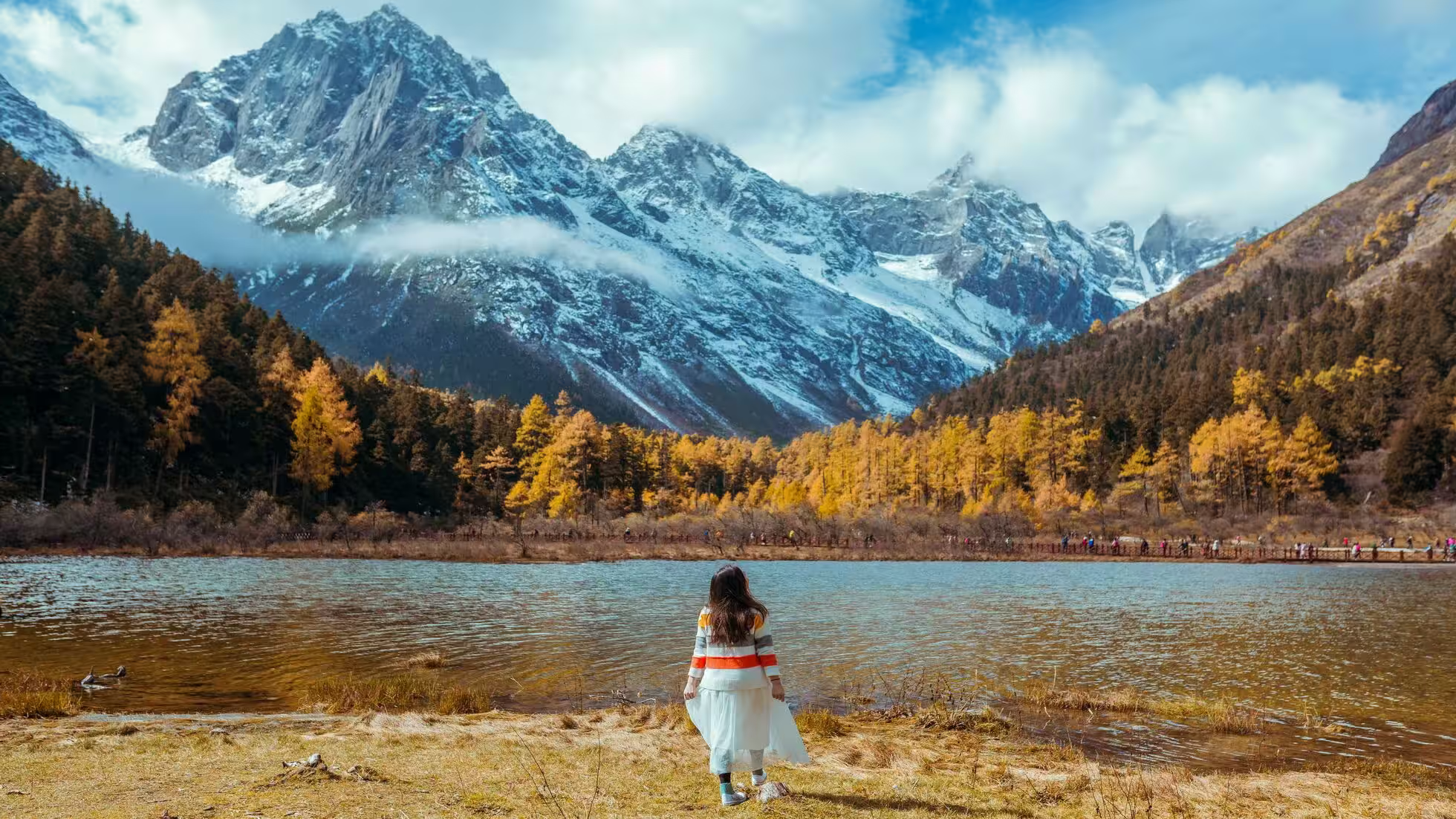
Wuxuhai is the core attraction of the scenic spot. It is long and narrow, surrounded by green mountains. The riverbeds on the east and west sides degrade during the dry season to form alpine meadows. Standing on the meadow and looking far away, huge rocks are covered with white snow, and a crescent moon hangs in the blue sky.
Walking from the east meadow of the lake to the west meadow of the lake along the road around the lake, towering spruce and metasequoia stand on the alpine frozen soil along the way, covered with usnea. There are trunks that have just fallen down, covered with moss, and the sun shines on them, quiet and peaceful. Some dead trees have been blown by the wind, exposed to the sun and invaded by water, and the bark has fallen off, leaving only bare trunks, which is quite desolate.
The water flowing down from the waterfall draws a beautiful stream on the meadow and flows into the Haizi. In winter, the stream forms a white icy cover. The stream water passes through the ice cover and flows into the crystal clear Haizi. Looking at the snow-capped mountains across Wuxuhai is another beautiful scenery.
Published at: Jan 8, 2022 · Modified at: Jan 14, 2026