How to Narrow the Three Gaps from the Perspective of Zhejiang Agricultural Expo
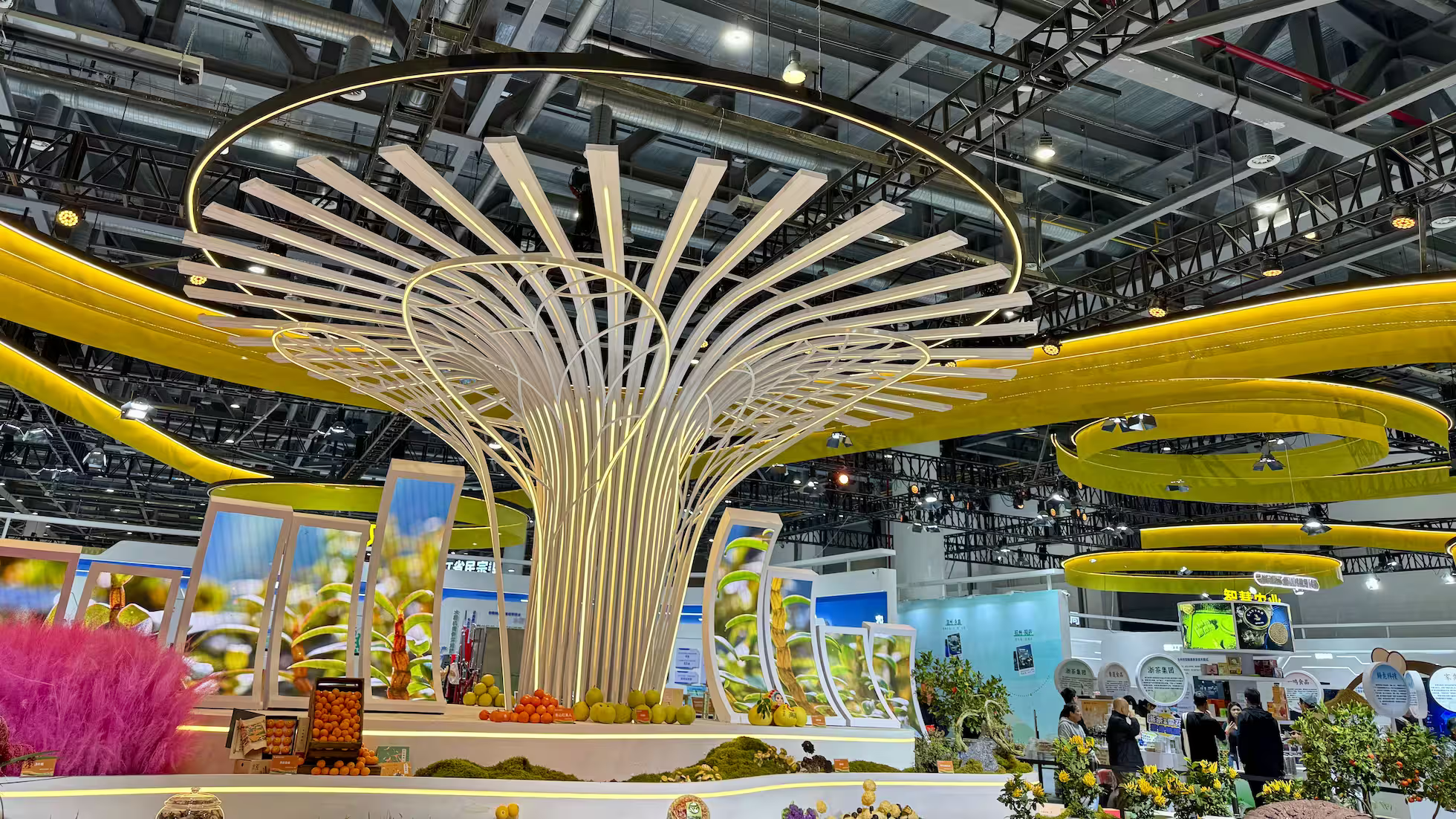
I went to the Zhejiang Agricultural Expo on Monday. One reason was very routine—to see what new things were there this year and buy some delicious food to take home by the way; The other reason was a bit of an “occupational disease”—I wanted to see with my own eyes what that “big phrase” everyone talks about actually looks like when it lands on the ground:
Guided by the “Thousand Villages Project”, narrowing the urban-rural gap, regional gap, and income gap.
As a result of wandering around all day, I brought back a bag of unpalatable Guizhou tea and a pile of scattered thoughts about the “three gaps”. Just treat this as a “field observation” in the style of a personal travelogue.
The moment I entered the hall, the most intuitive feeling was: Even on a workday, it was crowded as usual.
People pushing small carts, carrying canvas bags, holding children’s hands, plus a few scattered people who were obviously “here to see projects”, several streams of people slowly intertwined in the middle of the exhibition hall. As I followed the crowd turning inside, I quietly set a small task for myself for the day: Put the filter of “narrowing the three gaps” on my eyes and take a good look at this carefully packaged agricultural world.
I did take a serious tour of the smart agriculture exhibition area. Field systems, plant factories, seedling factories, and small transplanters, the equipment and screens were all complete. If you only look at the “sense of technology”, this part is absolutely not embarrassing—the lights are on, the interfaces are bright, and it fits our imagination of “modern agriculture” very well. But the reaction of a few aunties next to me was very simple: “Oh, so advanced.” After saying that, they turned their heads to look for food.
In that instant, I understood a little: For ordinary audiences, these “wisdoms” are quite far from their wallets and dining tables. If you ask them “how much more money can these farmers make” or “who will pay for these systems”, probably no one can explain clearly.
This involves the first gap—the urban-rural gap. On the surface, it seems that “farmers’ things have entered the city” and “there is a grand agricultural exhibition in the city”. But without a stable, long-term docking mechanism, agricultural products and farmers just come to the city for a “short stay” for a few days, which is two different things from truly “integrating into the daily life of the city”.
This was most clearly seen near the exit. I stood there for a while on purpose, as if I were doing a very crude “sample survey”: To see how many things everyone actually loaded into their shopping carts.
When many people came in, they were pushing empty carts and carrying folding bags, with “going to make a big purchase today” written on their faces; When they came out, the things they actually carried were not many—
- A little dried goods: shiitake mushrooms, bean products, things that are not expensive and do not have too strict taste requirements;
- A few scattered packs of specialty snacks;
- Big gift boxes and boxes of agricultural products were few on the contrary.
On the city side, the venues, organization, and flow of people were all prepared; On the rural side, products, stories, and display boards were all moved over. Both sides tried very hard, but the real “transaction” line was not as thick as imagined. This is the reality version of: “It looks like urban and rural areas are in dialogue, but the relationship is actually still very short-term.”
Let’s talk about the regional gap. In the Agricultural Expo, delegations from other provinces are a group of people who are very capable of creating an atmosphere. Sichuan, Guizhou, Yunnan, Shanxi… rows of stalls, you can tell where they are from as soon as you hear their accents, and the things also have distinctive local characteristics: tea, cured meat, chili sauce, oranges, tangerines. The problem is not whether they come or not, but: Are they “here to sell goods” or “here to build long-term links”.
The bag of Guizhou tea I bought is a very typical small sample: 500 grams for 50 yuan, it looks like a very good deal, and the stall owner spoke very nicely too—“high mountain tea”, “pure handmade”. As a result, when I brewed it this morning and took one sip, only one sentence remained in my mind: I won’t buy it again next time.
From the perspective of “narrowing the regional gap”, this one-time experience is actually quite dangerous:
- For the stall owner, he might think “I sold pretty well these few days”;
- For me, this is “silently blacklisting this brand in my heart”;
- For this tea area, an opportunity to build a reputation in the Yangtze River Delta was lost in vain.
In the same exhibition hall, the brands that Zhejiang itself has done more maturely are already talking about the whole industrial chain, standards, origin stories, and even village collective dividends and driving farmers’ income. While many delegations from other provinces are still stuck in the stage of “come once, sell out the goods, and leave”. This is another reality version of the regional gap: The stage can be the same, but the “production level” and “follow-up tour ability” of the program still have a big gap.
The third, and also the most sensitive one—the income gap. Prices at the Agricultural Expo are generally a bit higher than daily farmers’ markets, and some are quite a lot higher. If the experience is worthy of the price, then this is called a “premium”; If the experience is not worthy, then it becomes a “lesson from one-time consumption”.
The few things I encountered this time were a bit interesting:
- Tea: As mentioned before, cheap but not tasty;
- Dongxiang mutton: Small box, about 100 grams, 50 yuan. The taste is okay, but this price makes it hard to convince people to buy a few more boxes to stock up at home;
- Barbecue skewers: 25 yuan for a big meat skewer, I stared at the price list for several seconds, and what came to my mind was “scenic spot logic”;
- Freshly squeezed orange juice: 10 yuan a cup, mixed with water, the operation process was a bit rough, and the look and taste were very average.
Adding these up, it is a very intuitive impression: The exhibition wants to talk about “increasing farmers’ income” and “rich local specialties”, this is no problem; But if the product experience and price do not match, the small account book in the consumer’s heart will be very honest—“I can support once, but forget it the second time.”
Narrowing the income gap, in essence, is about letting farmers make more money over a longer period of time and through more stable ways, rather than relying on “a few days of exhibition, a few impulse purchases”. If you want farmers to stand further ahead in the value chain, the premise is that the product itself can really support that position: Quality, stability, brand, service, hygiene details… any shortcoming in any of them will discount the long-term effect.
After wandering around all day, I actually didn’t come to any high-sounding conclusions, but became more convinced of a simple thing:
“Big phrases” like “narrowing the three gaps” must eventually be implemented in very trivial details.
For example:
- The urban-rural gap might be hidden in “can you still easily buy this village’s things in your daily life after the exhibition ends”;
- The regional gap might be embodied in “do delegations from other provinces come to hit and run, or is someone accompanying them to design brands and build channels”;
- The income gap might be written in “after drinking this cup of juice and brewing this pot of tea, are you really willing to pay for the second time”.
The Thousand Villages Project, common prosperity, three major gaps, these words are very grand in documents; But after walking into the Agricultural Expo, squeezing through the crowd, and carrying that bag of unpalatable Guizhou tea home, they became more concrete in my mind.
When I go to see similar exhibitions in the future, I will probably have a fixed action: Not just looking at display boards, not just taking photos of big screens of “smart agriculture”, but staying a while longer at the exit to see:
- Whether the things in everyone’s carts are many or not;
- What kind of things they bought;
- Whether their expressions say “I found something good”, or “I’ll just make do with buying a little”.
That might be closer to whether the “three gaps” are really narrowing than any propaganda poster.
Published at: Nov 25, 2025 · Modified at: Jan 14, 2026